Abstract

Omar Yaghi, co-recipient of the 2025 Nobel Prize in Chemistry, has left his endowed chair at UC Berkeley to lead a new AI Chemistry and Materials Research Institute at Tsinghua, where he was received with a high-profile campus welcome. The story uncovers China's long-term acquisition strategy. Simultaneously, the appointment gives China both research capacity and reputational standing.

“US science is not so encouraging because of the cutting back on grants.”

Omar Yaghi · Scientific American, via Nature, July 2026

The wider movement of scientists from the United States predates the most recent disputes over research funding. Annual departures of US-based scientists of Chinese descent increased from approximately 900 in 2010 to 2,621 in 2021. The movement also reaches senior scientific ranks, while surveys have recorded concerns about professional security and continued residence in the United States.

China has positioned itself to receive this talent through honorary affiliations, academy memberships, senior appointments, research institutes, and highly visible institutional ceremonies. Yaghi's relationship with Tsinghua developed over several years before his full-time move, demonstrating how recruitment can operate as a staged process rather than a single offer.

The strategy also extends beyond scientists leaving the United States. Recent recruits have come from Europe and Singapore and range from early-career professors to senior Nobel laureates. Europe is simultaneously attempting to attract some of the same globally mobile researchers through dedicated funding and relocation programmes.

The central argument of this brief is that a high-profile scientific appointment can create two returns. It can expand research capacity through laboratories, doctoral students, institutional leadership, and publications. It can also produce reputational visibility through ceremonies, international media coverage, and association with globally recognised scientific achievement.

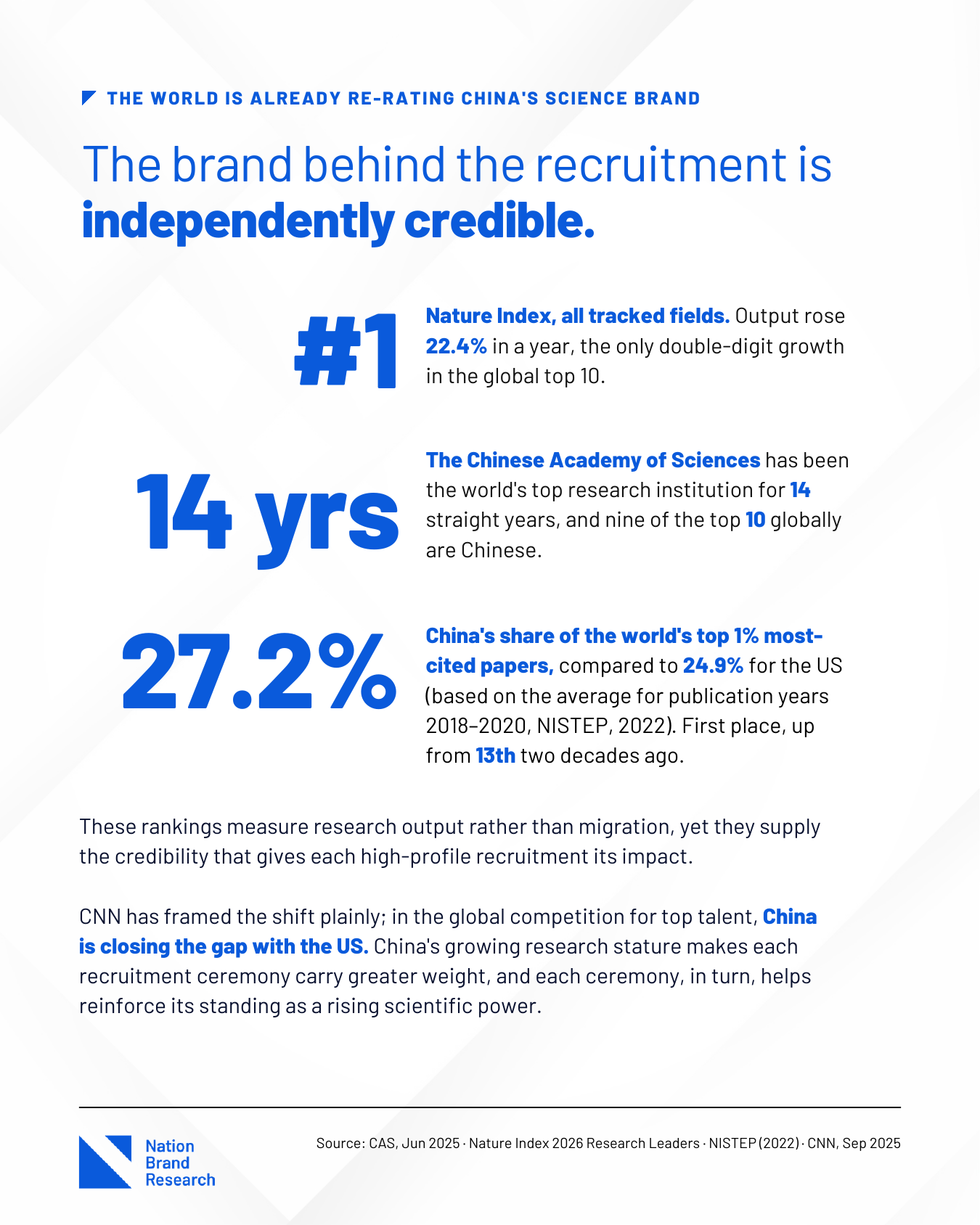
These rankings measure research output rather than migration, yet they supply the credibility that gives each high-profile recruitment its impact. China's growing research stature makes each recruitment ceremony carry greater weight, and each ceremony, in turn, helps reinforce its standing as a rising scientific power.